
Due Stoppini | Two Wicks
A small candle. Two wicks. It couldn't hurt.

Italy routinely displays a special kind of warm humanity that isn’t found everywhere. A willingness to meet people where they are, emotionally, in whatever drama is unfolding that particular day.
Elena, for example, who works in my office. A very local woman of middle age whose Italian is so heavily accented that she seems to me at times to live inside a word cloud. Her anecdotes, mostly concerning her adult daughter, her dog, or the extended reaches of her family, can be difficult to follow even when the subject matter is simple. She has taken a warm interest in my son Victor, who at fourteen is in his first year at a liceo scientifico here in Florence — a school with a solid reputation even among Florentines for being genuinely difficult.
Victor is struggling in Latin and Italian, which he considers peripheral to his actual interests. He is, he will tell you, primarily a scientist. A mathematician. A physicist! This may be true. I have tried to explain that literature and Latin have been important to a great many scientists across thousands of years of history. Yet Victor is fourteen and unmoved. This is normal.
Last Tuesday his Latin professor called him to the front for an interrogazione — the oral examination, conducted standing before the class — and Victor told her he was not prepared. The format is unforgiving: a perfectly memorized passage, reproduced without errors or pauses. The professor fails the student at the first stumble. Sit down. You fail. Victor got an incomplete, which in some ways was worse. His Latin tutor was clear: he needed to offrirsi on Thursday.
Offrirsi is its own Italian-school art form. You raise your hand and volunteer to be examined before the teacher calls on you. It signals good faith. It can soften even a very strict professor. Even one who is spietata, a new word I learned thanks to this whole saga. Merciless. Without mercy. Senza pietà. In contrast to the other evidence pointing toward general Italian humanity.
Thursday morning I found Victor awake an hour early, Latin notebooks and papers spread out across his bed like a papyrus fan. “Get out,” he said grimly. “I’m studying.” I walked him to school on my way to work. He was surprisingly buoyant — calmer than I expected, given that Victor lives with a heightened baseline of anxiety and has been known to fly off the metaphorical rails under genuine pressure.
When I got to the office, Elena looked up immediately. “Come va Victor?”
I told her everything. The incomplete grade, updates on the stern professor (who is more sympathetic to us in parent-teacher conferences than she may convey to Victor in class), the early morning with the papyrus bed, the whole saga of offrirsi and salvaging the year and the looming threat of summer school.
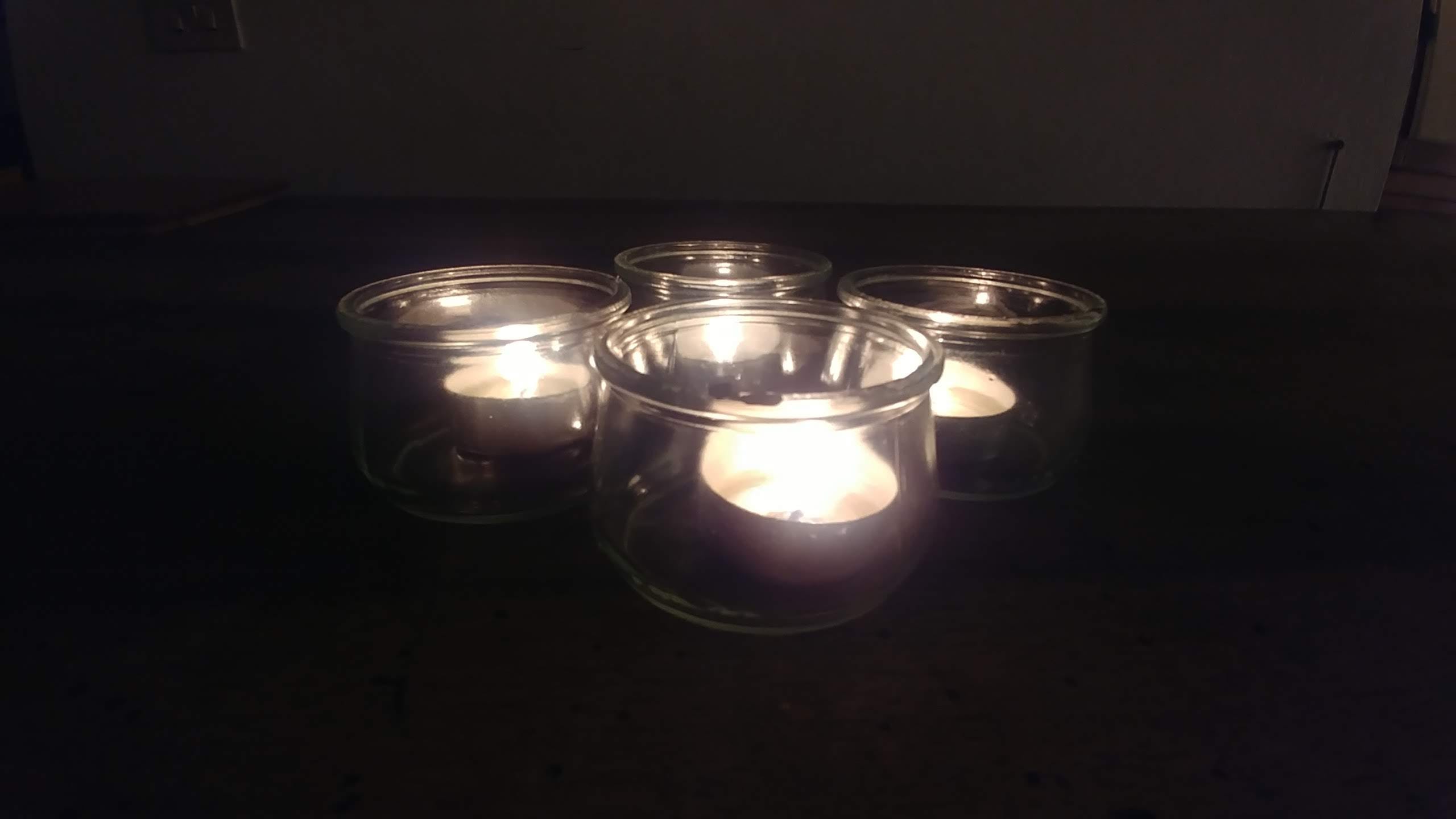
Elena listened. I said, “let’s light a candle for Victor.” I meant it metaphorically. She looked at me and said, “get a lighter” and sprang into motion, reaching for the butane lighter we use for the fragrance candle in the office. “Let’s light it right now,” she said. “Look — two wicks. That’s worth two candles.” She lit the first, then the second. “There. We’ll leave those burning until you go home. Remember to blow them out so we don’t get in trouble.”
At that moment I felt completely reassured. Not because lighting candles necessarily works (though who knows), but because of the gesture itself — the immediacy of it and the seriousness with which Elena recruited the physical world on behalf of Victor’s Latin crisis to send up a heavenly petition for aid.
It turned out that Victor could not offer himself on Thursday, because the professor gave that day’s interrogazioni over to Italian (everyone needs a certain number of grades by year’s end, and Italian schools record far fewer of them than I remember from America). Victor could not offer himself on Friday either — the waiting list of students was already too long. Offrirsi is only an option if there’s room. And at this late phase in the school year, many classmates are ready to pounce and offrirsi.
It might happen today. It is Saturday.
In the meantime, I’m going to light another candle at home.
I will light a candle as well.