
Europe-Forward
On travel as consumer good, so-called cultural credentials, and life more richly lived

Why do people want to travel?
What do they think is going to happen when they go far from home? What do they think they’ll find there, and why do they want to find it?1
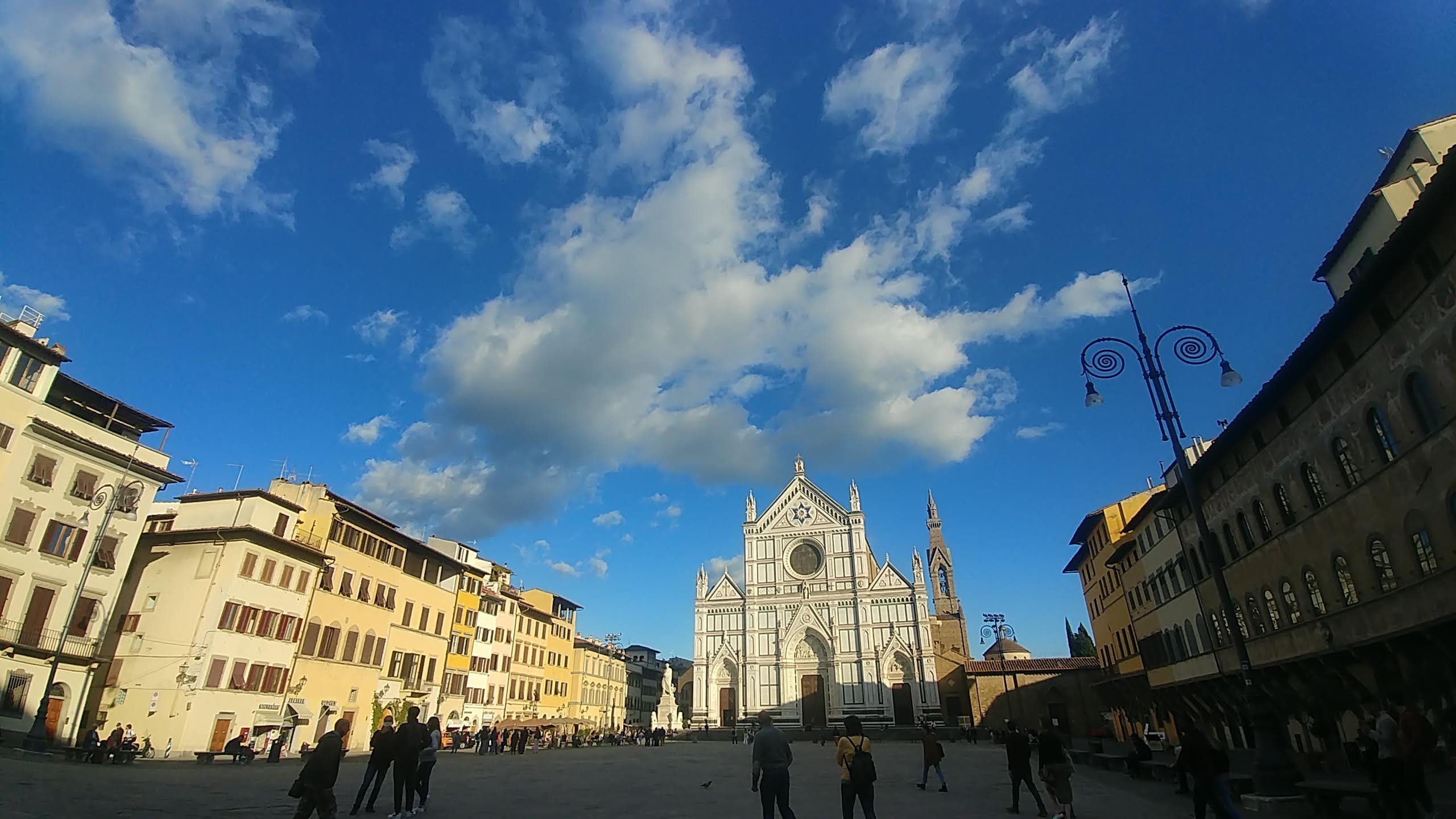
In a life spent online, scrolling through images and posts of people doing things that look considerably more fun than sitting on a sofa in Bolton or Columbus, people want to eat the food themselves. They want to smell things and see things. They want to taste and hear. The digital facsimile of life is not enough.
The more people sit at home on their sofas and go to work at jobs they don’t like, stuck on the treadmill of employment and scarce vacation, the more they feel certain: there has to be a richer, more embodied life out there. One they can find. One that looks like an affogato al pistachio at Tivoli in Santa Croce (thanks, Instagram) or a panino al crudo e pecorino in Piazza San Marco (ibid). Ironically, many of the digital simulations of places they might actually go are constructed from cleverly composed photographs that bear little relationship to conditions on the ground.
But why do people travel, really?
(This question, and its implications, was very recently well-covered in this piece. Set aside some time; the author, a latter-day Fukuyama, gives the curious mind a sublime 9,300 word read):

It’s a dispatch from a world that still exists, where the five senses can engage. That’s part of what drives the impulse. If social media felt like enough, no one would be flying anywhere. But that’s not what’s happening.
There is a machinery behind it all. The desire to travel is real, but it did not arrive unassisted. The consumer loop runs on aspiration: desire is manufactured, fulfillment is sold, and the gap between the two is carefully maintained so that the consumer returns to the market. (The tourist plans more trips!)
What is insidious about this particular loop is that it has moved well beyond advertising. It is no longer enough to show you an image and tell you that you want it. The dream has been inserted upstream, into the fabric of daily life, into the phone you scroll through before you get out of bed, into the algorithm that knows your wants before you have consciously formed them. We did not simply absorb these desires from billboards or television spots. They are threaded into the hours, the idle moments, the commute, the pre-sleep.
It has to be real, right? Surely travelers cn go there and experience it themselves. L’Antico Vinaio awaits!
By the time you realize you, too, want to be standing in Piazza San Marco with a panino in your hand, you have already been wanting it for years, nudged incrementally by a system that profits from the wanting as much as from the purchase. Is the fulfillment, when it comes, real? Does it matter? The next iteration of desire is already queued and waiting, full of promise.
For a significant portion of the general population, travel represents a consumer good. You buy it, you consume it, you bring the trophy home and display it. At best, it confers bragging rights; at a more aspirational level, it functions as a shortcut to cultural capital, a cube of sophistication dropped into your head where your brain is supposed to be.
That was my college roommate’s read on my first semester in Spain, January to June 1993: you just purchased a block of culture and put it in your brain. (My time in Spain was not tourism, as I was on a one-semester academic course in Santiago with a very limited budget. But it was viewed as tourism.) She mimed lifting the top of her skull and dropping inside an invisible, purchased block of experience and culture, like a primitive software update, sharpening the charge considerably. Her conviction was absolute: I had gone to Europe, performed the gesture of culture, and returned unchanged except for the external credential. I could not dissuade her. No amount of testimony from the defendant could move the jury. She wasn’t wrong that some people do that. She was wrong that I had.
Ten years later, she moved abroad for work and traveled widely throughout Asia. I don’t know whether she feels she inserted a corresponding block of culture into her brain. I wonder if someone asked her.
For me, the desire to travel began earlier and ran deeper than any algorithm. I grew up at the intersection of several worlds that didn’t quite match the one outside the door: Finnish grandparents who spoke English with an accent and kept another language entirely for home; a paternal cousin who had studied in Paris and spoke French; a maternal uncle and two aunts who traveled widely and well, and came back with the unmistakable quality of curious people who had been somewhere and were willing to interrogate their own assumptions.
The outside culture? Oklahoma. Sit with that. I was bored, ashamed, amused and angry by turns.
The inside culture was something considerably more complicated. I studied Spanish, then Latin, then French, then German, then more. Many more. I majored in Classics and Spanish. A dabbling drama student, I had an appetite for standup and improv, which turned out to be the most useful preparation for independent travel I could possibly have had, because travel, when you’re doing it on your own without a net, is essentially improv. You say yes. You follow the scene where it goes. You stay in the moment: the moment is all you have. The funniest things happen fastest, and the moments when everything went most wrong were reliably the moments when I made the best new friends, many of whom remain so today.
A wise older relative, with whom I made two life-changing trips to Finland in 2003 and 2006 told me once, with the particular authority of someone who had watched me carefully for a long time: never stop traveling. You get more out of it than anyone else anywhere, I reckon. I carry that with me still. What I was looking for was not a cube of culture to drop into my head. I wanted to close a cognitive distance with experiential knowledge.
Spain, in 1993, was a match for my curiosity.
I am cynical about an advertising ecosystem that markets carbon-heavy escapes from boredom while investing nothing in the educational scaffolding that might make those escapes meaningful. Who’s taking language or history before travelling to understand where they’re going? Who’s top goal is to be respectful of a destination, rather than going all-out with the “I saved for this, I’m going to make the most of it” attitude?
I believe that many people do not want to be changed, not fundamentally.
Change, in whatever form it comes calling, is almost always uncomfortable, and (almost always) carries a cost in the form of what we discard, or what is discarded for us.
As far as travel, people want their own expectations affirmed: that their own life at home often feels hollow and unfulfilling, for any number of reasons; that someone, somewhere, is living a richer and more embodied life than they are; and that, for the right price, the right sacrifice of time and money, they too can access that life for a finite period. Also, they just want to be amused. Bread and circus with a heavy carbon footprint.
And then go home. And report back to others who may feel trapped on their sofas and in jobs and in the digital world, with its feeble approximations of lived experience. From one unreal world to another.
We could make an argument for banning billboard advertising of petroleum-centric products outright, airfare among them, on the grounds that we are selling a costly and polluting solution to a problem we have also manufactured.
And yet the counter-argument arrives just as quickly: if travel becomes the exclusive domain of the wealthy and the well-resourced, populist nationalisms already metastasizing across the globe will just gather more force. People who have never left become people who fear what lies beyond, and that fear is enormously useful to certain politicians whose fiats further divide our world.
The question of what travel actually does to a person, whether it transforms or merely confirms, whether enlightenment is even the right word for it, merits a separate essay. What I will say here is that enlightenment, if it happens at all, is rarely a thunderclap. It sits on a spectrum. The eureka! moment is far less common than the slow, cumulative loosening of certainty that comes from having been, repeatedly, somewhere else.
At a more basic level, somewhere around the middle of Maslow’s pyramid, leisure travel offers bragging rights. And an aspirational desire to prove social mobility. Because travel abroad signals something specific: a certain social safety, the ability to pay, the ability to access. Access to privilege. Access to elite experiences. Which means, possibly, better odds of not only survival but hedonistic enjoyment. The embodied life, finally, in full.
So it is worth sitting with, quietly and without agenda: why do we want to travel? Why do I, why do you?
What activities correlate with travel as genuine agents of growth and change, and does anyone actually want to grow and change?
I suspect that is a minority impulse, more minority than we like to admit. Most people want confirmation, not conversion. But larger questions queue behind that one, and they are harder.
Is “enlightenment” even possible, in any meaningful sense, and if it is, does a long-haul flight burning several tons of carbon into the atmosphere represent a reasonable price of admission? What about the overrunning of quiet capitals and historic neighborhoods, the Venice problem, the Lisbon problem, the Barcelona and Amsterdam and Paris and London and Berlin problem, the problem of every beautiful and fragile place that has become an itinerary stop?
Could slow travel become the new brass ring, the considered and unhurried alternative to the influencer itinerary, the twelve-cities-in-ten-days sprint? Or is slow travel simply too expensive in time and money to be anything other than another privilege of the already privileged, a boutique option for people who can afford to move at a different pace than everyone else?
I don’t have clean answers to any of this. I have, as you can see, a great many questions. I remain committed to the questions, welcome new questions, and am always open to revising any and all opinions based on fact, and sometimes, perspective.
Thanks for reading, following and commenting. Comment thread is now open!
I address here questions surrounding short-term travel and leisure tourism. I am not addressing issues surrounding the challenges and contours of a transnational life, a life transplanted, lived abroad, in good faith, in an acquired language and respectfully navigating a “host culture.” These circumstances are different, and are not, for me, interchangeable.
That’s beautiful!
This post first caught my eye as that's my husband's favourite Piazza in Firenze (and our favourite hot chocolate place is located there too).
Thanks, you have given some good food for thought.