
Rake and Mow
An incendiary essay about the American yardspace. Of public parks and private lawns.

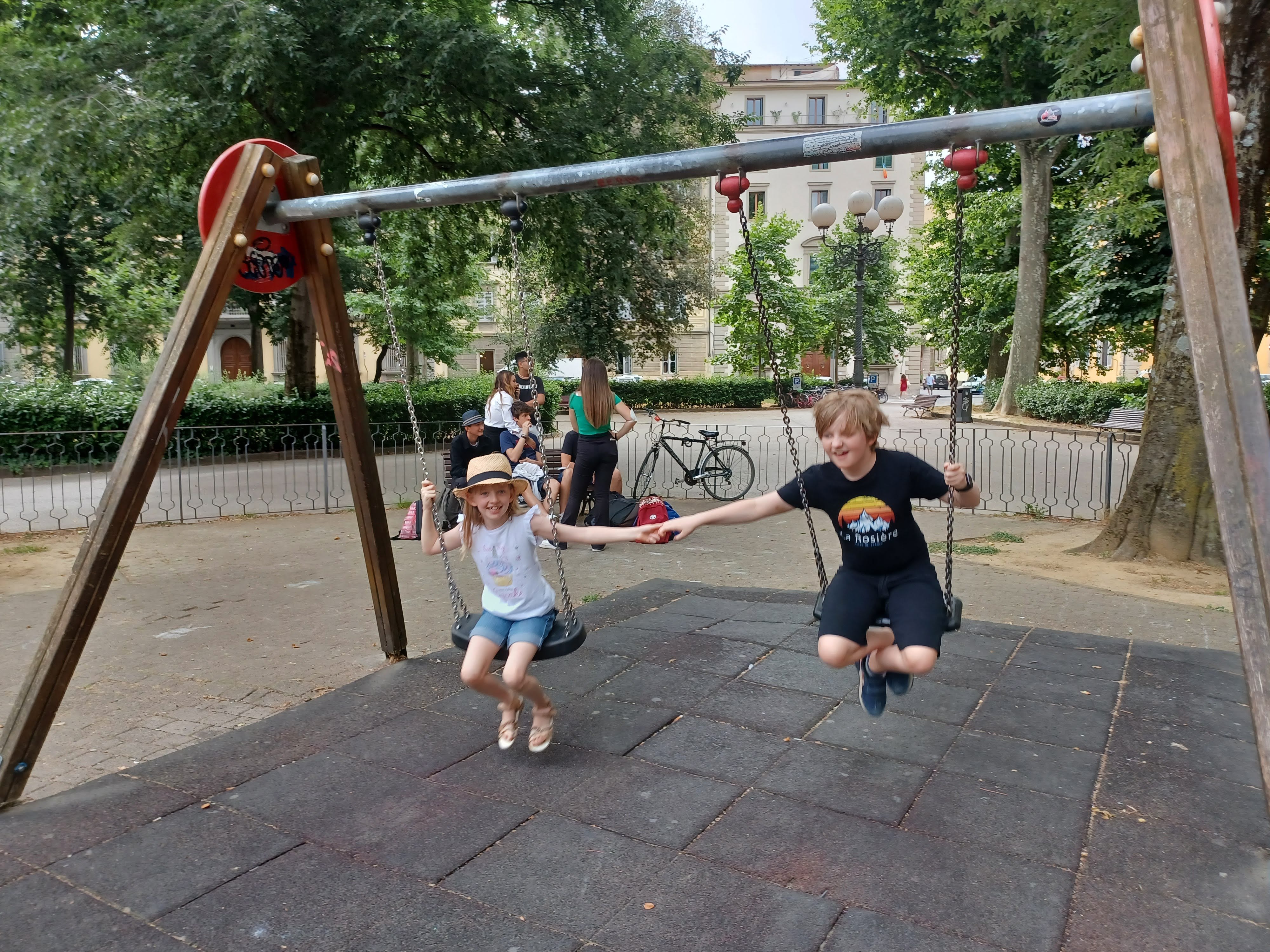
Something I think about, having grown up in America, and now even stranger in hindsight than it seemed at the time, is how much our family life revolved around yard work.
Not just our family. Everyone’s. Every weekend, every fall, every spring. The mowers and edgers and rakes, the bags of mulch, the coiled hoses in the garage. The specific anxiety of being called in from whatever you were doing because it was time to rake leaves, or sweep the drive, or help haul yard waste to the curb.
Our family was esssentially maintaining a private park. An acre of lawn and flower beds and, in our case, a pool (which I loved — I will never complain about growing up with a pool in Oklahoma) that functioned like a small urban green space, accessible to our family and maintained entirely by us.
No crew came to work. My parents bought everything. My brothers and I were conscripted seasonally whenever possible. The whole street was doing the same thing — sixty houses, sixty private parks, sixty families spending their weekends in service to their lawns.
The Alameda in Santiago, l’Orangerie in Strasbourg. Plane trees and public lawn? Sign me up.
Piazza d’Azeglio in front of our apartment is a proper public garden — enclosed, tree-lined, with benches and a fountain and a small playground, and city workers who regularly tend it. The Alameda in Santiago, l’Orangerie in Strasbourg. Plane trees and public lawn? Sign me up. Millions of people use public parks every day in Europe, the continental public living room.
Maintenance cost is distributed, space is shared, and no one’s twelve-year-old is being handed a rake on a Saturday morning.
The contrast is almost too clean to be useful. But I keep coming back to why the American model looks the way it does. Some of it is surely the Midwest specifically — the space, the scale, the cultural expectation that you maintain what’s yours. Also a little bit of keeping up with the Joneses, and the protestant idea of a thriving, thick lawn as a reflection of a Healthy Soul and Prosperous Family.
I suspect the root to be specifically American: private property as a moral category, arriving with common law from England and then amplifying in a country where land itself was the founding promise.
In Oklahoma especially, where I grew up, this carries difficult implications. The 1889 Land Run — in which land taken from Native American tribes was ceremonially “reassigned” to poor settlers who literally raced to claim it — made private acreage the founding mythology of the state. You didn’t share a commons. You staked a claim. The yard was yours, and the yard was you. Yarrr!
The yard was yours, and the yard was you.
Ironically, this ideology of private land ownership didn’t come with the aristocratic resources to actually tend the land like an owner. No Fitzwilliam Darcy strolling about with a riding crop! Instead of public parks maintained by paid workers, we got private lots maintained by the resident family on weekends.
The English grandmother with her cutting garden, her herbs, her roses — that I understand. There’s pleasure in that, craft, intention. But a push mower and an acre of turf? That’s not a garden. That’s a statement. A chore. Run away!
I never liked yard work. I was bad at it and resented it and I am here to report that I have not raked a leaf since leaving Oklahoma and I am at peace with that.1 On a street where everyone was doing it, the pressure was self-reinforcing. The lawn was proof of something. I did enjoy keeping my little plots of flowerbeds and Icelandic poppies in Seattle and pots of kitchen herbs in Oklahoma, when I could keep them alive through sweltering summers and the recurring winter ice ganache. But that was hardly a multi-acre mow. And we paid through the nose for yard service in Oklahoma before we moved to Italy. Left to my own devices, I would have definitely let the yard re-wild, neighorhood opinion be damned. Who can afford the American double whammy of daycare and yardwork? No one.
I am here to report that I have not raked a leaf since leaving Oklahoma
and I am at peace with that.
Piazza d’Azeglio fills up every day. Public workers with city-issued equipment complete in a couple of hours what sixty families were doing all weekend — sixty private parks, sixty push mowers, sixty people who had somewhere else to be. The park is beautiful. The people using it are happy. And somewhere in Oklahoma, someone is reluctantly raking leaves.
Hilarious, and tragic.
We have consistently, however, assisted with local grape and olive harvests in the past ten years. This also involves raking olives out of a tree. There is always a nice lunch on offer afterward.
Rakes ! You don't realize you lived through the good old days of yard work, Monica. Now it's all 2 cycle leaf blowers that operate at some ungodly decibel level, usually around when you're getting home from work, ready to relax with some peace and quiet. Fortunately, living on a boat, I dodge most of the suburban yard syndrome. It's so bad that some towns, like Seattle, have started banning the infernal machines. America is a noisy place, and it's harder and harder to get away from it. Of course, here, most people are oblivious, or in some twisted way, like it.
I like working in the yard. My fingernails are dirty from weeding today, and I very much enjoy having gathered enough rocks to surround my place with stone walls. Good fences make good neighbors, and I was tired of dog owners using my yard as a canine toilet.
I see the city council in Livorno now makes dog owners not only pick up the poop, but carry water to rinse away the pee. Bravo!
I used to watch big leashed dogs crashing through my flower beds and whizzing all over the shady grass. Now, I enjoy my battery-powered mower, which is mercifully quiet, minimally vibratory, and free of noxious fumes.
Watering the flowers is fun, too, and virtually requires a chilled Vermentino.
—————-
I’m fair-skinned, but I love the sun,
Despite what every doctor said.
So now I sport a broad-brimmed hat,
To shield the cancers on my head.
Thus kitted out, I weed primroses
Ignore that crop of keratoses. ,
Then as the sun begins to set
I get the flowers nice and wet.
Some fertilizer for the hosta,
A pink wine from the Valle d’Aosta.
I sink into my favorite chaise;
That’s home-grown basil in my Caprese.
A bowl of pasta with Romesco
Completes my garden snack al fresco.
I banish thoughts of loss and death,
Except my deadly garlic breath.
I’m too relaxed to sweat caesura
Expressing a gardener’s sprezzatura.