
What Feeds You
Notes from a Florence Literary Society craft workshop

Wallis Wilde-Menozzi — American poet and essayist, decades in Parma, author of Mother Tongue and The Other Side of the Tiber — stood before a room of writers in a church undercroft in Florence on a Saturday morning and began with one question, brought to her by Jonathan Galassi years ago, when he found her writing in The Kenyon Review and eventually published her at Farrar, Straus and Giroux.
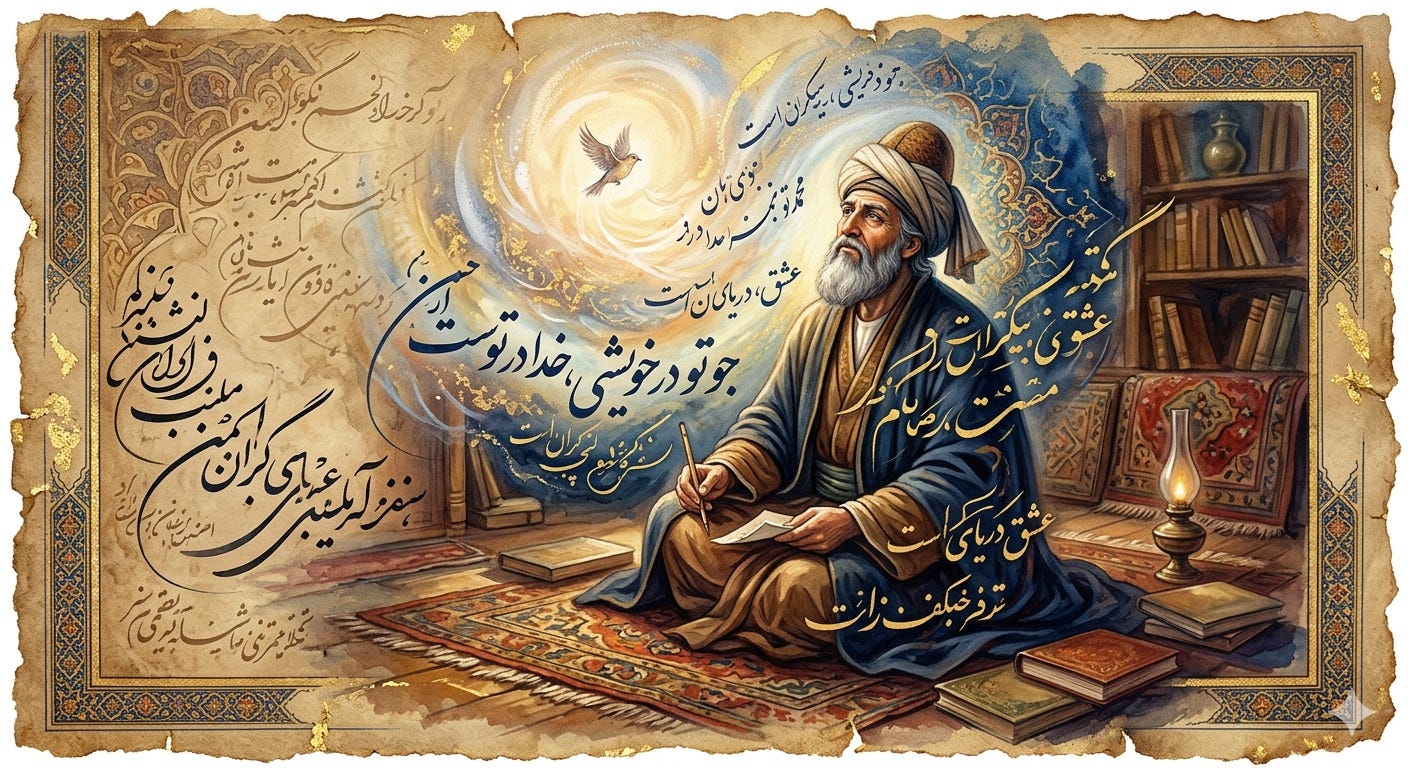
She set us going with a Rumi poem; his words and spirit remained with us for the duration of the workshop. I was glad for this as a longtime fan of Rumi and the Colman Bark (2026+) translation, with unforgettable art by Michael Green.
Do you have a sense of why and what you write?
Do you believe in what you write?
The room was charged in a collective hum of Florence Literary Society members who gathered to deeply consider their inner lives. Wallis made ambling a method.
She recounted the blank journals — fifty of them — left by the mother of the author Terry Tempest Williams. Why were they blank? Out of fear, or rebelling, or rage?
She referenced key mistranslations: the kiss between Clarissa Dalloway and Sally Seton, rendered in the 1946 Italian edition as an exchange of a rose and corrected only in 2011. Sixty-five years of mistranslation.
What is the right to narrate? she asked. Is it a human right?
She instructed via accumulation. The fragments will eventually cohere — this was one of her central points.
Mosaic writing, she called it.
Arranging and editing are not separate from writing; they are writing.
In the first prompt, she asked us to amble about like Rumi’s camel around what interests us as writers. To nibble that knot and untie ourselves.
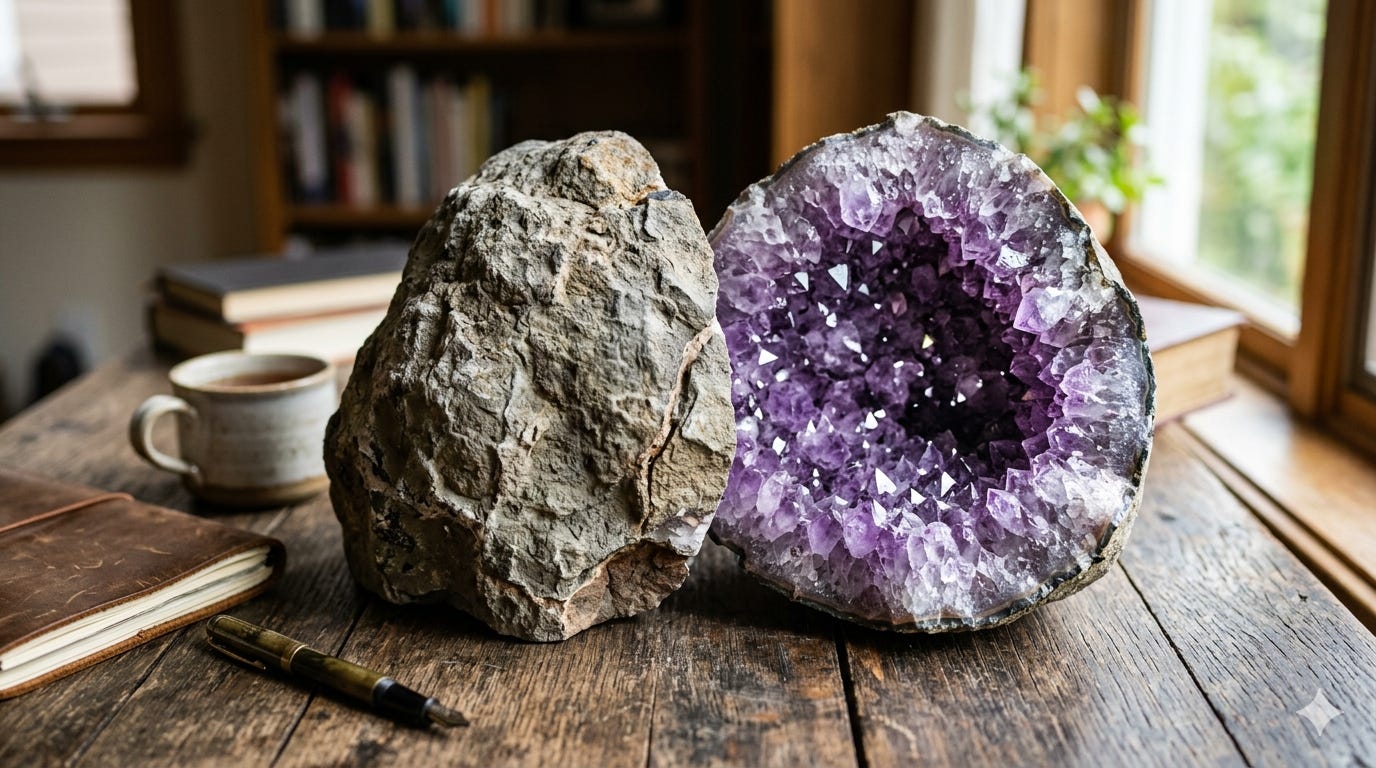
I love to notice, to penetrate, to see — really see inside things, people, places, actions. What is an ordinary rock to a passerby? To me, with a hammer and a deft whack, it reveals a hidden world of snow-white and lavender crystal peaks. There is beauty everywhere for those who truly care to see it. I examine character and motives, unraveling fiction to understand why. Keats: truth is beauty, beauty truth — even the most tremendous, terrible topics begin to shine with clarity when we understand. Reveal secrets. Keep safe other secrets. Tuck in, hide, vouchsafe. Explain, refract, understand. Every well-written paragraph clarifies mundane confusion and lets us walk in brilliance, in an illuminated world.
Everything is so surprising. Always.
I was reminded of Anne Lamott’s exhortation that we have to stop not-writing. Stop doing dishes or rearranging your sock drawer. Do not sweep the floor. Do not worry about next year’s taxes. Be free to amble. This doesn’t get easier with practice but we do get better at recognizing avoidance for what it is.
Wallis reminded us: AI cannot grow. We writers are the only true source of origial content.
She didn’t linger on it. She moved on. But it stayed with me, sitting in that undercroft next to thick stone walls with the sounds of the street outside. She had stated the obvious truth — briefly, as if what mattered was what came before and after: free time, freedom of charge, liberty.
To be a writer is to drink a special wine.
The second prompt: what are my topics?
My topics are language, culture, travel, humanity, mutability, processing, understanding, noticing, mulling, connecting, reading, growth, people, spirit, soul. These are the building blocks of a life, and of a life well-lived. To write about them is to communicate companionship, hope, trust, transformation. What interests me most is the place where self-discovery meets universal illumination and understanding. To expand, encompass, hold. To protect and keep safe. To splash out and live large. To treasure. To commune. To share. To have, to hold. To release. To go further, farther. To circle home. Life as a spiral, not a line.
The third prompt asked us to go somewhere harder.
Maybe I never needed to explain anything. The only truths worth telling were communicated with perfect logic and poise. And yet the noon bell tolls its bronze tones every day, like clockwork. There is no logic we need generate. We make sense, logic or no. We need not impose. We are whole and coherent as we are.
Toward the end of the workshop we discussed journaling. The group shared different perspectives on journaling, both their own and legacy journals left by family members. I wasn’t aware until the workshop that Latter-Day Saints keep family journals to pass their stories on to later generations. My paternal grandmother Esther kept a journal in 1939 and 1940. Could it be used as a resource for some writing? Wallis suggested interrogate your motives first. And then: there is no single answer. There are infinite answers.
Wallis is finishing a translation of Antonella Anedda’s Emerging from the Winter Sea, an edition of bilingual prose and poetry. She has a book forthcoming from Farrar, Straus and Giroux — Moving — on Trump’s world, our world, the environment, old age, writing.
Things just happen if you do them. Do what you do. Admit what you cannot do.
In the said, there is always the unsaid — and the task, in writing and in memoir especially, is to leave space for it.
I biked home along the diminshing summertime Arno thinking about something I’d written in my notes during the first prompt: a rock, ordinary to a passerby, but cracked open with a hammer to reveal crystal: the glittering world that was there the whole time.
I think Rumi would have really appreciated that metaphor.
Wallis Wilde-Menozzi’s books include Mother Tongue and The Other Side of the Tiber (both FSG). Moving is forthcoming. Her essay collection L’Oceano è dentro di noi is available in Italian.
Monica, Oh, wow. I can only imagine what this must have been like. It sounds almost transcendent. I want to know more about this group!!!! How lucky you are to have this beautiful community.
Thanks for sharing this, several things struck a chord…the fragments will eventually cohere…arranging and editing…and the idea of refracting among other things, marvelous and relevant to me, my painting, and of course life itself.