
The Changing Dialect
On popped collars, Kennebunkport, and invisible competence

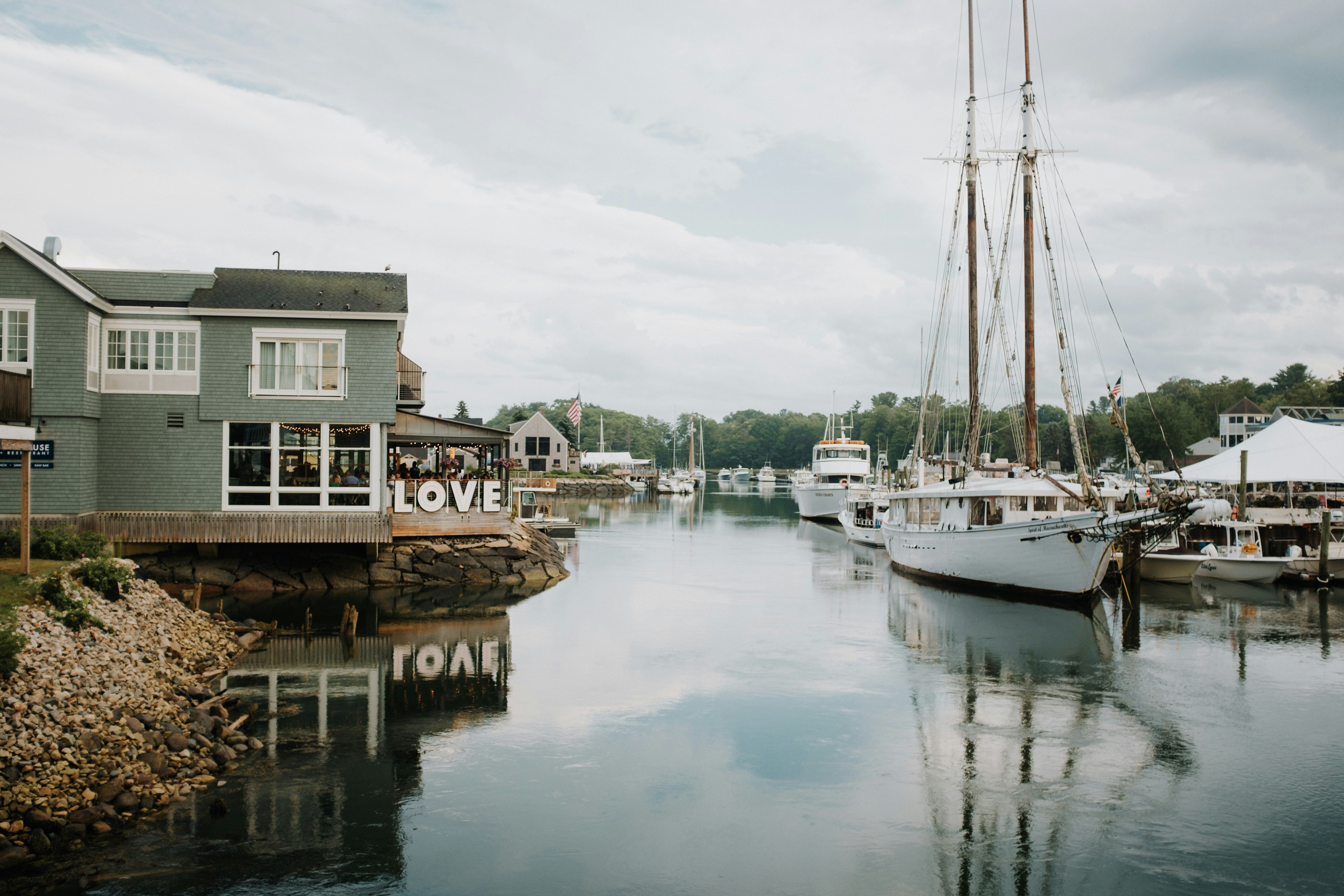
I have been thinking lately about gold nugget chain necklaces.
Not metaphorically. The literal ones — thick, rope-twisted, 14-karat, worn by fourteen-year-old girls in Edmond, Oklahoma in 1987 over the collars of their polos (best when borrowed from a cute boy — either chain or the polo with the popped collar).
Popped collars, naturally. Shod in Cole Haans or Sebagos.
Socks? Never.
We read The Preppy Handbook without irony (“Look, Muffy, a book for us!”). We didn’t know the signified truly existed. We thought the signifier was the reality.1 The satire lost on our adolescent selves, there in the American midwest. The social commentary of John Hughes films utterly obscured by the dominant cultural messaging of the era. My future is in yours ears.2
Greed is good.3
People who have money don’t need people.4
Our high school wardrobes demonstrated the acid brightness of wealth performed at low stakes — coral, mint, canary — colors that said I summer somewhere even if the someone in question had never left the state or seen the ocean.
Sailing, takes me away to where I always heard it could be ….5
Where were the yachts? Where were the sailors? Where were the equestrian training farms we were clearly and sartorially preparing to inherit?
Nowhere. There were no yachts. We were in Oklahoma.
Maybe there was a horse somewhere. Hardly a thoroughbred though.
We read The Catcher in the Rye. A Separate Peace. We watched Dead Poet’s Society. Perhaps these were the worlds we should want?
The clothes from the mall bore aspirational, sailing-related brand names: Land’s End. LL Bean. Bar Harbor. St. John’s Bay.
But where were the yachts?
I am not referencing class anxiety, exactly. But I have been thinking about class. I am mulling something more specific: the experience of being fluent in a language that keeps changing the dialect on you. Of becoming expert in a grammar that turns out to belong to a place you will never actually live. (For example, I understand Red State fluently, but refuse to speak it.)
We were Gen X. We were the children of the 70s, the children of the aftermath. By the time we got to high school, the story we had absorbed — handed down by the dominant culture, reinforced by the Reagan administration and the particular sociology of a prosperous white suburb in the middle of the country — was that the social experiments had failed. Feminism. The Civil Rights Movement. The Great Society. All of it: well-intentioned, embarrassing, over.
I don’t think now that social change failed. I think we were told that it had, which is a different and more insidious propaganda.
But we were teenagers, and teenagers believe the weather they’re standing in. And the weather in 1987 was: that was then. This is now. Now is Reaganomics and shoulder pads and Schwarzenegger, and the implicit understanding that the people who had pushed for change had lost, and that it was unkind to draw attention to the loss, and that the correct response was to turn away and dress to win.
The winning “costume,” in Edmond, Oklahoma, looked like … Kennebunkport.
I can unequivocally state that none of us had ever been to Kennebunkport. Chances are slim that any of us could have found it on a map. But we knew it the way you know a myth — as a place where “the real people” lived, the people whose power was so settled and secure that it didn’t need to announce itself, whose clothes were worn soft with actual use rather than stiff with aspiration.
We were aspiring. Visibly, effortfully, absurdly. We wore the uniform of a leisure class whose leisure we did not share, whose institutions we would not attend, whose world would not, in the end, open its doors for us simply because we had worn the right boat shoes in a landlocked state for four years.
And yet.
We were not nothing. We were prosperous by any measure, by every metric. We were being well educated. We had holidays. Large dogs were often at home. Many people skied! People swam! We were going places — or more accurately, we believed that we were going places, which at seventeen amounts to the same thing.
We doubled down because the alternative was to look like we had lost, and we had absorbed, completely and without question, the lesson that losing was the worst thing you could be.
Plus ça change ….
I have been thinking about this for a while. The lesson carried a second verse that we didn’t notice we were learning.
The first verse was: winners look like this. Dress accordingly.
The second verse was: competence is a costume. Wear it right and it will carry you.
Fake it til you make it.
I was good at the costume. I was good at school, good at language, good at the performance of serious professional personhood. I accumulated credentials and positions and a fluency in the codes of American professional life that felt, for a long time, like actual power.
Then I moved to Italy.6
I don’t mean this as a complaint. I chose it. I love it. Truly.
But I feel at times a genuine vertigo in that the “language” I spent thirty years becoming expert in is not a universal language. That the grammar of American professional credibility — the cadences of the resume, the handshake, the institutional affiliation, the understood hierarchy of accomplishment — is a local dialect. Useful in one place only.
In Florence, my credentials barely parse. Not because I lack them, but because the system is different. The institutions and cultures that conferred my credentials mean nothing here, if they register at all. The professional lineage I spent decades building reads, at best, as a curiosity, if at all.
Where are the yachts?
This is not a tragedy. There is something clarifying about discovering that my fluency is geographic, that what I believed was competence was partly costume, that the club I dressed for — Kennebunkport, university, Corporate America, the Great Meritocracy — was mostly myth.
Gen X does not seek membership. We never did. What we sought — what I sought — was legibility. To be “read” correctly by others. To have what we were doing be recognized and valued.
The dialect keeps changing. First: dress like I summer somewhere. Then: credential into seriousness. Then: translate this self into my fourth (?) language.
I am still learning. I have been learning my whole life. I have made of my life a kind of experiment. How much can I learn? How hard will it be? Can I slip through, or will I stick out? Or will a spotlight shine? I am a professional American in my fifties in a medieval city with a useless curriculum vitae and a growing suspicion that the experiments — the ones we were told, as teenagers, had failed — hadn’t failed at all.
They just hadn’t finished.
See https://www.ebsco.com/research-starters/literature-and-writing/mythologies-roland-barthes
Some Kind of Wonderful (1987). The film, featuring the iconic line “You look good wearing my future,” is an 80s classic.
“Greed is good” is a famous, often-misquoted line from the 1987 film Wall Street, delivered by the character Gordon Gekko (Michael Douglas).
Alex P. Keaton (Michael J. Fox) from Family Ties was known for his pro-capitalism and conservative views, famously states in the show, “People who have money don’t need people.”
Due to copyright restrictions, the full lyrics for "Sailing" by Christopher Cross cannot be reproduced here.
To clarify, this was not a “cold” move. Jason and I have been frequenting western Europe and living here, off and on, since 1993. But the 2016 move was undertaken as a permanent move, more or less. I knew what I was getting into, more or less.
Though my family had come down the economic ladder we still ranked high on New England social scales from earlier generations. I attended Deerfield Academy, was part of the elite old boy network. I had a foot in Kennebunkport, you might say. The optics are enticing, but believe me, snobbery, racism, elitism are rampant in those waters, and life there is not worth the price of admission. You can't really buy your way in anyway. You need to be born there. Consider that you dodged a bullet : )
Oops. Premature launch! Take 2:
In the Maine Coast town where I grew up,
There was an understanding:
There were three yacht clubs,
A boatyard, and the steep-approach Town Landing.
There were small but sharp divisions between sail and motor sailors;
Was your a craft a classic J-boat
Or a rakish Boston Whaler?
My hair bleached white, fair skin grew brown,
Like half the other kids in town.
We guzzled Heinies on most nights.
The girls all smoking Marlboro Lights.
I’d often crew on Martha’s boat,
A beauty, named “The Reef”.
An apt reward for Martha’s Dad, who straightened crooked teeth.
I had no braces, but I came to know their feel
When I’d kiss a girl who had them
And my tongue encountered steel.
We swam like fish. We drank like fish. Had Tuna fish for lunch.
We raided parents’ stocks of beer, made Purple Jesus punch.
My breath smelled then of Camel Straights, and was distinctly malty.
We cherished our reputations:
Worldly-wise and pretty salty.
We wore a sort of uniform,
Painter pants and Lacoste,
Sebago Mocs out on the docks
Even when there was frost.
Our carefree ways disguised a cult of self-enforced restraint.
Grown-ups will let you borrow boats
If you don’t fuck up the paint.
Even now I can spot folks of that tribe, walking a Black Lab pup.
Clean but threadbare jeans,
Just like in their teens,
Izod collars standing up.